data-driven look at El Gouna, Sahl Hasheesh, Soma Bay & Makadi
There are many compelling reasons to invest in the Egypt Red Sea region. Egypt’s Red Sea coast has emerged as one of the most closely watched real estate and lifestyle investment regions outside the European Union. Over recent years, international investors, second-home buyers, and long-term residents have increasingly allocated capital to this region—not due to marketing narratives, but because of measurable economic data, tourism growth, and real estate fundamentals.
This article explains why investors are investing in Egypt’s Red Sea, and how El Gouna, Sahl Hasheesh, Soma Bay, and Makadi serve very different investor profiles.
The macro case for investing in Egypt’s Red Sea
The Red Sea region benefits directly from Egypt’s broader economic recovery and tourism expansion, which are key drivers of real estate demand.
Key economic and tourism data:
-
Egypt welcomed approximately 15.7 million international visitors in 2024
-
Tourism contributes roughly 12% of Egypt’s GDP
-
The tourism sector supports around 2.7 million jobs
-
Real estate represents approximately 20% of national GDP
-
Residential property prices increased by ~18% year-on-year in 2024
These figures are critical for investors. Tourism-led economies generate sustained demand for both short-term and long-term accommodation, and coastal regions with established infrastructure—such as the Red Sea—benefit disproportionately from this demand.
One coastline, four distinct real estate markets
A common misconception is that the Red Sea functions as a single property market. In reality, capital allocation varies significantly by location, buyer nationality, and investment intent.
Understanding these distinctions is essential for risk-adjusted decision-making.
El Gouna – Stability, residency, and long-term capital preservation
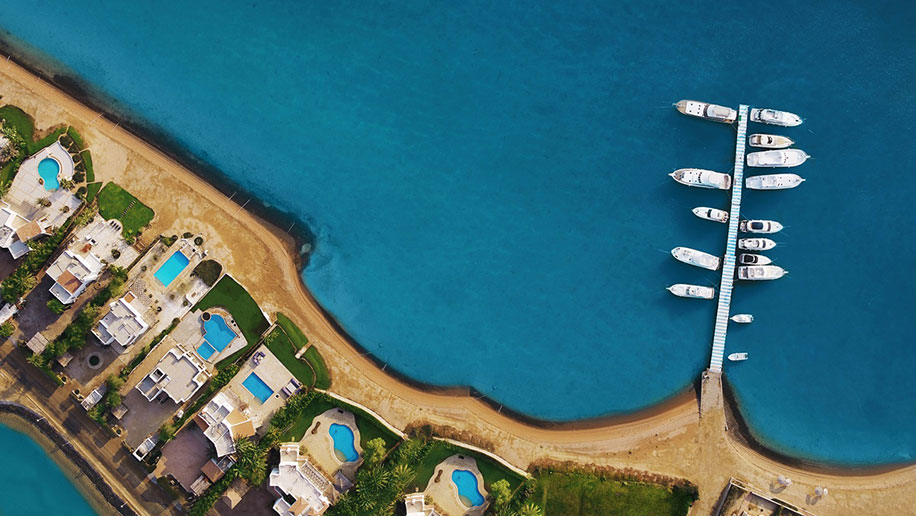
El Gouna is one of Egypt’s most established master-planned towns, with over 35 years of continuous development.
Key data points:
-
Approximately 25,000 permanent residents
-
More than 9,200 residential units
-
Residents from 50+ nationalities
-
Documented ~12% annual price appreciation on primary units
-
Asset appreciation of up to ~98% between 2019 and 2024 on selected stock
Typical buyer profiles:
-
German, Swiss, and Austrian investors
-
British buyers
-
European entrepreneurs and families
-
Egyptians earning foreign income
Investment rationale:
El Gouna operates more like a small European town than a resort. Demand is supported by a permanent population, international schools, healthcare facilities, marinas, employment opportunities, and year-round livability. This structure results in lower volatility and a focus on long-term capital preservation, making El Gouna one of the most stable real estate markets on the Red Sea.
Sahl Hasheesh – Rental yield and tourism-driven investment
Sahl Hasheesh is positioned primarily as a resort-oriented and rental-focused real estate market.
Key characteristics:
-
Large-scale beachfront developments
-
Strong hotel-driven tourism demand
-
Higher potential short-term rental yields
-
Historically lower entry prices compared to El Gouna
Typical buyer profiles:
-
UK investors
-
Eastern European buyers
-
GCC residents seeking holiday properties
Investment rationale:
Sahl Hasheesh appeals to investors prioritising rental income and vacation use. While yields can be attractive, the market is more cyclical and tourism-sensitive than town-based locations, requiring an income-focused investment strategy.
Soma Bay – Scarcity and strategic diversification outside the EU
Soma Bay is a low-density, premium destination built around controlled supply and high-end infrastructure.
Key characteristics:
-
Extremely limited development footprint
-
Golf courses, marina, and five-star hospitality anchors
-
Gated and highly secure environment
-
Strong emphasis on privacy, quality, and exclusivity
Typical buyer profiles:
-
High-net-worth European investors
-
German, Austrian, and Scandinavian buyers
-
Investors seeking capital allocation outside the EU
Investment rationale:
Soma Bay is not a mass-market location. It attracts investors with long holding horizons who value scarcity, security, and geographic diversification over short-term rental yield. For many European investors, Soma Bay functions as a strategic asset allocation outside EU regulatory frameworks.
Makadi – Growth-stage market and entry-level upside
Makadi, particularly Makadi Heights, represents a growth-phase real estate market within the Red Sea corridor.
Key characteristics:
-
Large-scale master planning
-
Lower entry prices compared to El Gouna and Soma Bay
-
Expanding infrastructure and town-centre development
-
Strong appeal to younger buyers and first-time international investors
Typical buyer profiles:
-
Younger European buyers
-
Remote workers and long-stay residents
-
Egyptians with rising middle to upper income levels
Investment rationale:
Makadi attracts investors seeking capital appreciation rather than immediate rental yield. It is positioned as a longer-term growth play, benefiting from early-cycle pricing and future infrastructure-driven value creation.
Why investors increasingly allocate capital outside the EU
Across Europe, real estate investors face:
-
Rising property taxes
-
Increasing rental regulation
-
Compressed real yields due to inflation
-
High entry prices in coastal markets
By contrast, Egypt offers:
-
Lower €/sqm entry points
-
Strong tourism-backed demand
-
Opportunities to invest outside EU regulatory frameworks
-
Exposure to a growing, consumption-driven economy
For many investors, allocation to Egypt’s Red Sea is not speculative—it is a form of geographic and regulatory diversification.
Key takeaway: allocation depends on intent, not hype
The Red Sea should be viewed as a segmented investment corridor, not a single market:
-
El Gouna → long-term stability, residency, capital preservation
-
Sahl Hasheesh → rental yield and tourism exposure
-
Soma Bay → scarcity and strategic diversification outside the EU
-
Makadi → growth-stage investment and entry-level upside
Successful investors align location choice with investment intent, not short-term market sentiment.
Final thought
Capital flows today are guided by data, structure, and risk management. Egypt’s Red Sea coast now offers clearly differentiated real estate markets that allow investors and buyers to position themselves deliberately—whether their objective is income, growth, lifestyle, or diversification.