
Homes for Sale in Japan: A Foreign Buyer’s Guide for 2025
The dream of owning property in Japan—a sleek Tokyo apartment or a serene countryside home—is a captivating one. Yet for many international buyers, this aspiration is often clouded by uncertainty over language barriers, complex legal frameworks, and an unfamiliar market. The process of searching for homes for sale in Japan can feel daunting, but it does not have to be. Imagine approaching this significant investment with clarity, assurance, and the confidence that every detail is being expertly managed.
This comprehensive 2025 guide is designed to be your trusted partner, demystifying the entire purchasing journey. Here, you will discover everything required to navigate the market seamlessly, from understanding the legal rights of foreign owners and avoiding hidden costs to identifying the ideal locations for your investment or lifestyle goals. Our mission is to empower you with the expertise needed to transform your vision of Japanese homeownership into a successful and rewarding reality.
Understanding the Japanese Property Market Landscape
Japan’s real estate market offers a unique blend of stability and opportunity for the discerning global investor. Unlike more volatile markets, it is characterized by transparent regulations and a deep cultural appreciation for property. For those exploring homes for sale in Japan, understanding its distinct principles is the first step toward a seamless and successful acquisition. This section provides the foundational expertise needed to navigate current trends, legal frameworks, and the core valuation concepts that define Japanese property with confidence.
Key Market Trends for Foreign Investors in 2025
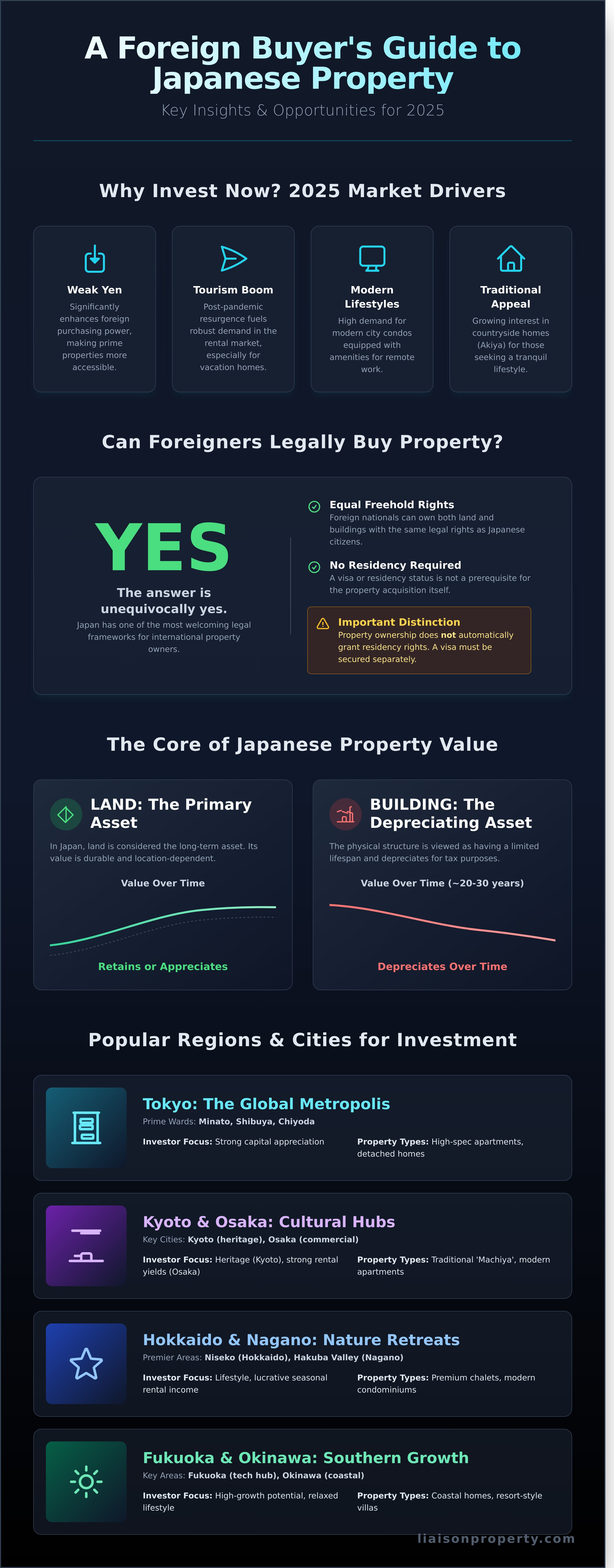
The current economic climate presents a compelling window of opportunity for international buyers. The historically weak yen significantly enhances purchasing power, making prime-location properties more accessible. Concurrently, Japan’s post-pandemic resurgence as a top tourist destination is fueling robust demand in the rental market, particularly for vacation homes and urban apartments. In-demand properties now include both modern city condominiums with remote work amenities and traditional countryside homes (akiya) that offer a more tranquil lifestyle.
Can Foreigners Buy Property in Japan? A Clear Answer
The answer is unequivocally, yes. Japan maintains one of the most welcoming legal frameworks for international property ownership. Foreign nationals can purchase and own both land and buildings on a freehold basis, affording them the same legal rights as Japanese citizens. This open approach, detailed in this comprehensive Overview of Housing in Japan, requires no residency status or visa for the acquisition itself. It is crucial for investors to understand, however, that property ownership does not automatically grant residency rights, which must be secured through a separate visa process.
Property Values: The Concept of Land vs. Building
A fundamental principle that distinguishes the Japanese market is the separation of land and building value. In Japan, the land is considered the primary long-term asset, which typically retains or appreciates in value based on its location. In contrast, the physical structure—particularly traditional wooden homes—is viewed as a depreciating asset with a limited functional lifespan, often fully depreciated for tax purposes over approximately two to three decades. This perspective is vital for a sound investment strategy, as it shifts the primary focus from the age of the building to the intrinsic and future value of the land it occupies.
Popular Regions and Cities for Your Japanese Home
Japan’s diverse geography offers a property landscape as varied as its culture, from hyper-modern cityscapes to serene natural retreats. Selecting the right location is the foundational step in your investment journey. Navigating the market for homes for sale in Japan requires understanding not just regional character, but also the evolving legal framework. Staying informed on updates like the New Property Registration Rules for Foreigners ensures a seamless acquisition. This overview is designed to help you align your search with your unique investment and lifestyle goals.
Tokyo: The Global Metropolis
As the nation’s economic and political heart, Tokyo presents a dynamic and highly liquid property market. Prime residential wards such as Minato, Shibuya, and Chiyoda are perennial favorites among international buyers, offering unparalleled access to global business, luxury retail, and fine dining. The market is dominated by modern, high-specification apartments (known locally as ‘mansions’) and exclusive detached homes, representing a sound investment with strong potential for capital appreciation in a world-class city.
Kyoto & Osaka: Cultural Hubs with Modern Appeal
The Kansai region offers a compelling blend of tradition and commerce. In Kyoto, investors are drawn to the unique opportunity to own and restore traditional machiya (wooden townhouses), preserving a piece of Japanese heritage. In contrast, Osaka is a bustling commercial powerhouse known for its vibrant urban culture and more accessible property prices. It is particularly noted for its strong rental yields, making it a strategic choice for investors focused on generating consistent cash flow.
Hokkaido & Nagano: Premier Ski and Nature Retreats
For those seeking an alpine lifestyle, Japan’s mountain regions are world-renowned. Hokkaido, particularly the Niseko area, has become a global hub for ski tourism and luxury property investment. Similarly, Nagano, home to the Hakuba Valley, offers stunning natural beauty and four-season appeal. The market here is centered on premium chalets and modern condominiums that provide both an exceptional personal retreat and a lucrative source of seasonal rental income.
Fukuoka & Okinawa: Southern Growth and Coastal Living
Beyond the traditional hubs, Japan’s southern islands present exciting growth opportunities. Fukuoka, on the island of Kyushu, is rapidly emerging as a dynamic tech hub, praised for its excellent quality of life and affordability. Further south, Okinawa offers a subtropical paradise with a market for coastal homes and resort-style villas. These regions represent compelling alternatives for buyers seeking high-growth potential or a relaxed, coastal lifestyle away from the main metropolitan centers.
A Guide to Common Japanese Property Types
Navigating the diverse landscape of homes for sale in Japan begins with understanding the distinct property types available. Gaining clarity on the local terminology is the first step toward making a confident and strategic investment. Our expertise is your advantage in demystifying these categories to find the perfect fit for your objectives.
Modern Apartments (Mansions)
Contrary to its English meaning, a Japanese mansion (マンション) refers to a modern condominium in a mid- to high-rise building, typically constructed from reinforced concrete. Prized for their urban convenience and security features like auto-lock entry, these properties are managed by a dedicated company. This ensures seamless maintenance of common areas, though it requires monthly management (kanri-hi) and repair fund (shuzen tsumitatekin) fees.
- Pros: Excellent security, low personal maintenance, prime city locations, and access to shared amenities.
- Cons: Monthly fees, less space compared to houses, and strict building regulations.
Detached Houses (Ikodate)
For those seeking greater privacy and space, the detached house, or ikodate (一戸建て), is the quintessential choice. Ownership almost always includes the freehold land, a significant long-term asset. Structures vary from traditional wooden builds, which have a culturally defined lifespan, to more durable steel-frame and concrete homes. An ikodate offers the freedom to have a garden, park a car on-site, and customize your living space.
- Pros: Land ownership, greater privacy, no monthly management fees, and more personalization freedom.
- Cons: Full responsibility for all maintenance and repairs, and often located in suburban areas.
The ‘Akiya’ Phenomenon: Vacant Countryside Homes
A unique corner of the Japanese property market involves akiya (空き家), or vacant homes. Often found in rural areas facing depopulation, these properties can be astonishingly affordable. An akiya can present a remarkable opportunity to own a piece of authentic Japan, but this path requires careful consideration. The low purchase price can be offset by substantial renovation costs, and their remote locations may not suit everyone. Diligent research is paramount when exploring these unique homes for sale in Japan.
- Pros: Extremely low purchase price, potential for a large traditional property, and an immersive cultural experience.
- Cons: Often require extensive and costly renovations, remote locations with limited services, and potential for complex legalities.
The Step-by-Step Purchase Process for Foreign Buyers
Purchasing a property in Japan can seem complex, but with strategic guidance, it becomes a clear and secure journey. The process is highly regulated and transparent, designed to protect all parties involved. Viewing this as a partnership with your chosen real estate professional is the key to navigating each stage with confidence. This roadmap outlines the four essential phases of acquiring your Japanese home.
Step 1: Engaging a Professional Real Estate Partner
Your journey begins by selecting a dedicated real estate agent, or fudousan-ya (不動産屋). It is crucial to partner with a firm experienced in assisting international clients. A seasoned professional does more than just browse listings; they act as your cultural and linguistic bridge, ensuring seamless communication and providing invaluable insights into the local market. This partnership is fundamental to successfully securing desirable homes for sale in japan.
Step 2: Making an Offer and Due Diligence
Once you identify a property, the first formal step is submitting a Letter of Intent (LOI) to the seller. While non-binding, it signals your serious interest. Before any contracts are signed, your agent will present the Explanation of Important Matters. This legally required document details everything from zoning laws and property boundaries to any known issues, ensuring complete transparency. This phase also includes professional property inspections and title searches for your protection.
Step 3: Navigating Contracts and Payments
With due diligence complete, you proceed to the formal sales contract. At signing, you will typically pay a deposit of 10-20% of the purchase price. This is where a shiho shoshi (司法書士), or judicial scrivener, becomes essential. This independent legal expert is responsible for verifying all documentation and ensuring the legal integrity of the transaction from contract to final registration, providing you with complete peace of mind.
The involvement of such a specialist highlights a key principle for any cross-border transaction: expert legal guidance is essential. For example, while a scrivener is vital in Japan, an Israel Cross Border Law Firm would be the go-to for navigating the complexities of business and investment between the US and Israel.
Step 4: Finalizing the Purchase and Taking Ownership
The final stage is the settlement, where you transfer the remaining balance to the seller. Your shiho shoshi will be present to confirm the transaction and immediately file the paperwork to register the property title in your name with the Legal Affairs Bureau. Once the registration is complete and funds are confirmed, the process concludes with the most rewarding moment: receiving the keys to your new home in Japan.
Let us be your partner in navigating this process with expertise and integrity. Contact Liaison Property for a consultation.
Understanding Financing and Associated Costs
A successful property investment begins with absolute financial clarity. To help you budget with confidence, we have outlined the key financial considerations when purchasing property in Japan, from initial financing to long-term ownership costs. Our commitment is to ensure you navigate this process with transparency and peace of mind, transforming a complex transaction into a seamless experience.
Can You Get a Mortgage as a Non-Resident?
Securing a mortgage in Japan without permanent residency is a significant challenge. Most Japanese banks require long-term residency status or a Japanese spouse to approve a home loan. Consequently, many international buyers exploring homes for sale in Japan proceed with a cash purchase. This approach simplifies the transaction and is often the most direct path to ownership for non-residents, providing certainty and speed.
A Breakdown of Closing Costs
Beyond the property’s list price, several one-time closing costs are required to finalize the purchase. These typically amount to an additional 6-8% of the property value. Key expenses include:
- Agent Commission: Calculated as 3% of the sale price + ¥60,000, plus consumption tax.
- Stamp Duty (Inshi-zei): A tax paid on the purchase agreement, with the amount varying based on the property’s value.
- Registration & License Tax (Toroku Menkyo Zei): A government tax for officially registering the property ownership transfer.
- Judicial Scrivener Fee: Payment to the legal professional who handles all registration paperwork and ensures the legal transfer of title.
Ongoing Costs of Ownership
Your financial commitment continues after you receive the keys. It is vital to budget for these recurring annual expenses to ensure a sustainable investment:
- Fixed Asset Tax (Kotei Shisan Zei): An annual municipal tax, typically around 1.4% of the property’s assessed value (not the purchase price).
- City Planning Tax (Toshi Keikaku Zei): An additional tax of approximately 0.3% levied on properties located within designated urban planning zones.
- Management Fees & Sinking Fund: For apartments and condominiums, these monthly fees cover communal maintenance and fund future large-scale repairs.
- Insurance: Fire and earthquake insurance are highly recommended for comprehensive protection of your asset.
Understanding these figures is the cornerstone of a sound investment. For a bespoke financial assessment tailored to your property goals, we invite you to connect with our team of dedicated partners. We are here to provide the clarity and expertise you need for a seamless acquisition.
Your Japanese Home Awaits: A Confident Path Forward
Embarking on the journey to purchase a home in Japan is an exciting prospect, one made entirely accessible to foreign buyers with the right preparation. As we’ve explored, understanding the nuances of the property market, the specific legal steps, and the associated costs provides a solid foundation for your investment. With this knowledge, you can confidently evaluate the incredible variety of homes for sale in japan, from serene countryside estates to modern urban apartments.
Success in complex international property transactions, however, hinges on having a dedicated partner. Liaison Property is founded on this principle. Our team brings deep expertise to your search, ensuring a seamless and transparent client journey from initial consultation to closing. We are committed to managing your acquisition with the integrity and diligence your investment deserves, transforming a complicated process into a rewarding experience.
Are you ready to transform your aspirations into a tangible asset? Begin your international property journey with a trusted partner. Contact Liaison Property for expert guidance. Your new life in Japan awaits.
Frequently Asked Questions: Acquiring Property in Japan
Do I need a visa or to be a resident to buy property in Japan?
No, you do not need a specific visa or residency status to purchase property in Japan. The country’s laws permit foreigners to acquire freehold land and buildings with the same rights as Japanese citizens. This policy makes the process remarkably straightforward for international investors. You will, however, need to submit a notification to the Bank of Japan within 20 days of the acquisition, a simple procedure your real estate partner can assist with, ensuring a seamless transaction.
What are the annual property taxes I can expect to pay in Japan?
As a property owner in Japan, you are responsible for two primary annual taxes. The first is the Fixed Asset Tax (Kotei Shisan Zei), typically levied at a standard rate of 1.4% of the property’s assessed value. The second is the City Planning Tax (Toshi Keikaku Zei), which applies to properties in designated urban areas and is usually around 0.3%. These taxes are based on the official valuation determined by the local municipality, not the purchase price.
Is it better to buy a new or a second-hand home in Japan?
The decision between a new or second-hand home depends entirely on your strategic objectives. New properties offer the latest in building standards and technology but often experience faster initial depreciation. Conversely, second-hand properties can present excellent value and a stable investment. When considering older homes for sale in japan, it is crucial to conduct a thorough inspection to assess structural integrity, a process where an experienced partner provides invaluable expertise and confidence.
How do I find a reliable, English-speaking real estate agent for Japan?
Securing a dependable, English-speaking real estate partner is fundamental to a successful purchase. We recommend seeking out agencies with a dedicated international client division or a proven track record of assisting foreign buyers. Online property portals catering to a global audience are also excellent resources. Most importantly, look for a firm that prioritizes transparency and acts as a true advisor, guiding you with integrity through every step of acquiring your ideal Japanese property.
What is the role of a judicial scrivener, and are they necessary?
A judicial scrivener, or shiho shoshi, is an indispensable legal professional in a Japanese property transaction. Their primary role is to manage the legal transfer of ownership and register the new title deed with the Legal Affairs Bureau on your behalf. Their involvement is not merely recommended; it is a standard and necessary component of the process. Engaging a qualified scrivener ensures that your ownership is legally protected and the entire transaction is executed with precision and full legal compliance.
Can I rent out my Japanese property to generate income?
Yes, foreign owners are permitted to rent out their Japanese properties to generate rental income. For non-resident owners, engaging a professional property management company is highly advisable. These firms provide a seamless solution for handling tenant screening, lease agreements, rent collection, and maintenance requests. This ensures your investment is well-maintained and provides a consistent return, even while you are managing it from abroad, offering you complete peace of mind.